Golf short game: 6 drills to save shots around the green


Well-designed short game drills are the fastest way to lower your scores. For a player shooting 90 or 100, a large share of shots are played within 50 metres of the flag. Yet on the driving range I always see the same scene: buckets of balls hit with the driver, and an almost empty chipping area. Here are six drills I give my players, each with a measurable target, so every session can be tracked.
Why short game drills need a measurable target
Hitting 50 chips at the same flag feels good, but it doesn't train much. On the course, you only have one ball, one attempt, and every shot is different.
A good short game drill has three ingredients:
- Variety in distances, lies or targets.
- A consequence: a score, a target to hit, a series to start again.
- A measurement you note down, to compare from one session to the next.
Write your results in a notebook or on your phone. After a few weeks, you'll see your progress in black and white.
6 short game drills, step by step
Each drill takes 10 to 15 minutes. Start with the ones that match your weak points on the course.
Drill 1: the bump and run into the zone
Stand 2 or 3 metres off the edge of the green, on a good lie. Pick a flag about 10 to 15 metres away. Mark out mentally (or with tees) a circle with a one-metre radius around the hole.
- Play 10 balls with an 8- or 9-iron, letting the ball roll as much as possible.
- Goal: 6 balls out of 10 inside the circle. When you manage it two sessions in a row, shrink the circle or change distance.
The bump and run is the safest shot around the green. The more time the ball spends on the ground, the more predictable it is.
Drill 2: the pitching ladder
With your sand wedge or lob wedge, pick three targets: roughly 15, 25 and 35 metres. Play one ball to each target, in order, then start again.
- Hit 5 sets of 3 balls.
- Target: 10 balls out of 15 finishing within 4 metres of their target.
This drill forces you to change distance with every shot, just like on the course. It develops your control of swing length, the key to pitch shots.
Drill 3: get out of the bunker every time
For most amateurs, the first goal in a bunker isn't to get the ball close to the hole. It's to get out every time.
- Draw a line in the sand, about 5 cm behind the ball. Your club should enter the sand on that line.
- Hit 10 balls to a nearby flag.
- Goal: 9 balls out of 10 on the green. Then move on to 5 balls out of 10 within 5 metres of the hole.
A failed bunker escape often means a double bogey. A successful one, even far from the hole, keeps the damage to a bogey.
Drill 4: distance putting
Three-putts rarely come from missed short putts. They come from a poorly judged first putt that leaves 2 or 3 metres.
- Place one tee at 10 metres, another at 15 and another at 20.
- Hit 3 balls at each target, changing target with every shot.
- Target: 7 balls out of 9 finishing within a metre of the target (in a zone one metre deep, long or short).
Focus on pace, not line. On long putts, a distance error costs far more than a direction error.
Drill 5: the short putt circle
Place 6 balls in a circle around a hole, about one metre away. Work your way round, playing each ball.
- Goal: hole all 6 balls in a row. If you miss one, start the whole circle again.
- Once you hole them easily, move back to 1.50 m, then 2 m.
Having to start over creates a little pressure, close to what you feel on the course. Use your pre-shot routine on every putt, just as in a round.
Drill 6: the 9-ball "up & down" game
This is the drill that brings it all together. Throw 9 balls around a green, in varied positions: good lie, bad lie, bunker, uphill, downhill.
- For each ball, play the chip then hole out with the putter, just like in a round.
- Count the number of balls holed in two strokes.
- Goal: start by recording your baseline score, then aim to beat it by one ball. For a player around 90, making 3 or 4 out of 9 is already a good level.
Note your score every session. It's your short-game barometer.
Organising your short game week
No need to spend hours. Two 45-minute sessions a week are enough to see progress:
- Session 1: drills 1, 2 and 4 (chips, pitches, pace control).
- Session 2: drills 3, 5 and 6 (bunker, short putts, up & down).
If you're aiming to break 100, this is often where it all starts. I lay out the full strategy in my article how to break 100 in golf.
Improving your short game with a coach
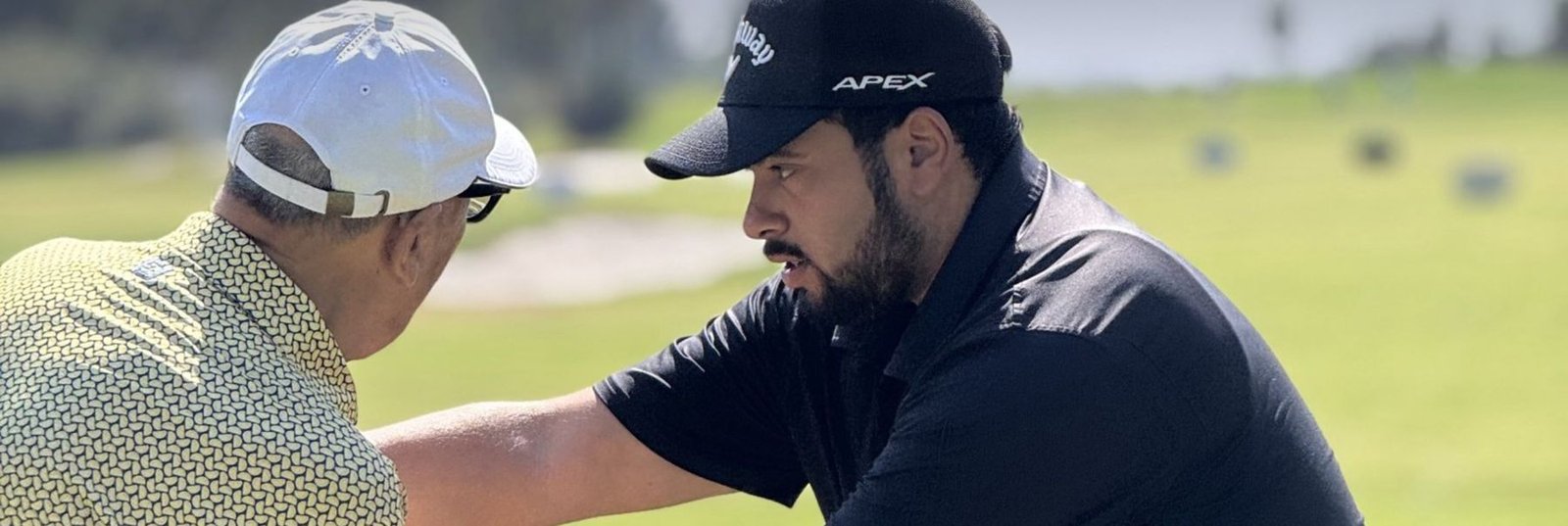
These drills work on their own, but an outside eye saves a lot of time: posture, club choice, ball position, feel for distance. On a progression camp in Marrakech, we can spend entire half-days on the short game, then put it to the test on the course. And if you can't travel, my online golf coaching lets you send me your videos and drill results, so we can adjust your plan week after week.