Taking up golf as an adult: where to start?
Taking up golf as an adult is a great idea, and it's never too late. I teach beginners aged 25, 45 or 65, and the ones who improve fastest aren't necessarily the most athletic: they're the ones who start with a clear framework. In this article, I explain where to start when you want to learn golf as an adult: equipment, first lessons, the driving range, the course, the basic rules and the pace to aim for.
Learning golf as an adult: the real strengths you have
You often hear that you need to have started as a child to play well. That's not true. Adults have real advantages:
- They understand what they're doing. You can explain the logic of a movement and it sticks.
- They can organise themselves. Two short sessions a week beat one long day a month, and an adult can keep up that pace.
- They're motivated. Nobody signed them up against their will. They're there because they want to be.
The only real trap is trying to learn on your own by watching videos. You'll pick up bad habits within weeks, and they'll take months to shake off. Your first hours with a coach are the best investment of your entire golfing life.
The minimum equipment to start golf
Don't buy a brand-new full set in your first month. You don't yet know what suits you. Here's what you really need:
- No clubs to start with. Most driving ranges and golf schools lend or rent clubs. Make the most of it for your first lessons.
- Next, a half set. A wood or hybrid, a 7-iron, a 9-iron, a wedge and a putter are more than enough for your first season. A second-hand half set will do the job perfectly.
- A glove. It's worn on the top hand (the left hand for a right-hander). It prevents blisters and helps keep a stable grip.
- Suitable shoes. Golf shoes with soft spikes or, at the very least, flat trainers with good grip. No smooth soles.
- Second-hand balls and tees. You're going to lose some. That's normal.
For dress code, check the rules at the club where you're playing. Generally: collared polo, smart trousers or shorts, no jeans or tracksuits.
Your first lessons: what to work on
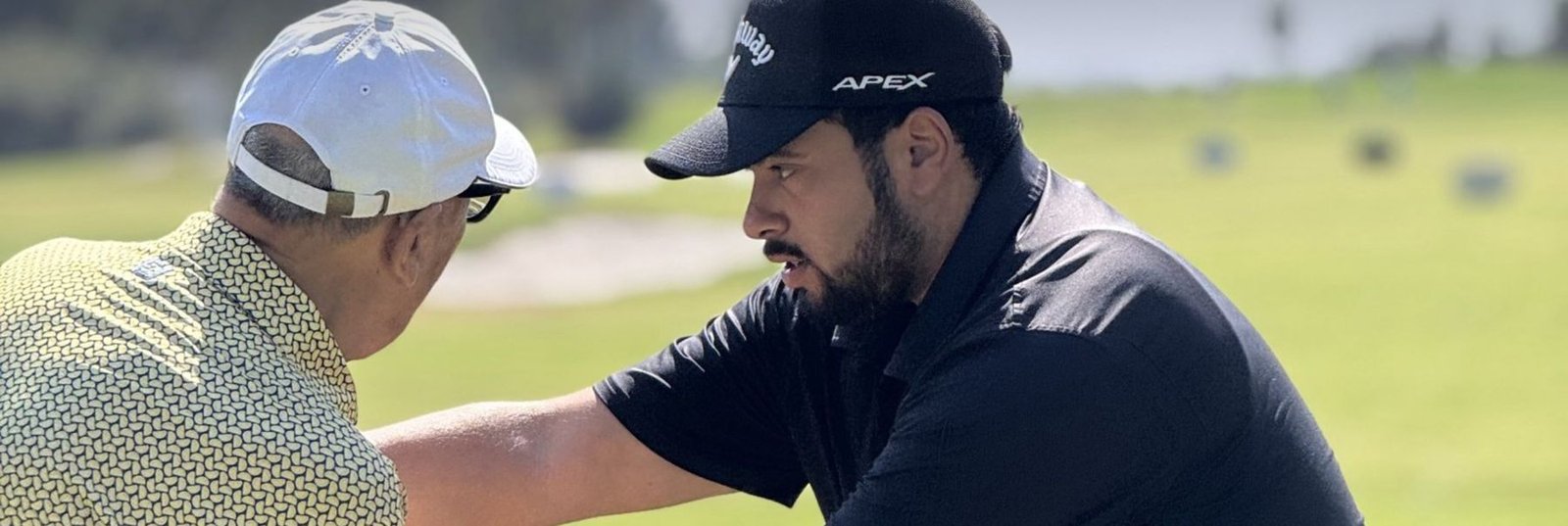
A good first lesson isn't about hitting 100 balls with a driver. In order, here's what I work on with a beginner:
- Grip and posture. They're the foundation of everything. Get the grip wrong, and everything after becomes compensation.
- Putting and chipping. We start near the green. The movements are short, you get results quickly, and that's where half the shots in a round are played.
- The small swing, then the full swing. We build the movement from the inside out: strike first, speed second.
- A first round with your coach. As early as possible, to understand the real game.
That's exactly the logic behind my Beginner pack: 8 sessions of 45 minutes, then a 9-hole round together to put it into practice. The short format helps you stay focused and fit several sessions into a week.
Driving range or course: how to split your time
The driving range is for building. The course is for learning to play. You need both, but not in just any proportion.
The first few weeks
About 70% of your time on the driving range and the short-game area, 30% on a short course (pitch and putt, compact or 9-hole). The course shows you what's missing. The driving range lets you fix it.
On the driving range, always with a goal
Hitting ball after ball is pointless. Pick a target for every ball, change clubs regularly, and spend at least half the session on the short game and putting. A simple example: 20 balls with a 7-iron at one target, 20 chips around a flag, 15 minutes of putts from 1 to 3 metres.
Etiquette: the basic rules to know
Golf has its etiquette. Respecting it means you'll quickly be accepted on any course. The essentials come down to a few points:
- Safety first. Never play if someone is within range. If a ball heads towards other players, shout "Fore!" without hesitation.
- Pace of play. Be ready when it's your turn. If you go past double bogey, pick up your ball and move on to the next hole. Nobody will mind.
- Respect the course. Replace your divots, repair your pitch marks on the green, rake the bunker after your shot.
- Silence. Don't talk or move while a playing partner is hitting.
To play the big courses, most federations and clubs require a minimum level or a green card. Check with your club or your national federation, for example the French Golf Federation.
A realistic pace to improve
Let's be honest: golf is a demanding sport. But with a bit of consistency, the milestones come faster than you'd think. Realistic benchmarks for an adult practising twice a week:
- After a few weeks: you make solid contact consistently and can play a short course without stress.
- After a few months: you're playing 9 then 18 holes, with some bogey holes and a few pars.
- In the first or second year: breaking 100 becomes a realistic goal.
These benchmarks vary a lot from person to person. What makes the difference isn't talent: it's consistency and the quality of your practice.
Mistakes to avoid when you start golf
- Buying too much equipment too soon. Wait until you know what suits you.
- Learning on your own. Bad habits set in quickly.
- Living with the driver in your hands. It's the hardest club. Start with short irons and the short game.
- Putting off your first round. Get out on the course early, even on a short course.
- Trying to fix everything at once. One focus per session.
Starting golf with a clear framework
If you want to take up golf the right way, the most effective approach is to concentrate your first hours with a coach. You can do this in private lessons, in Marrakech or Paris, with the Beginner pack. If you'd rather have a few days' immersion in the sun, the Beginner package of my Marrakech camp is designed for exactly that: on your own or up to 3 players, tailor-made, all year round.
And when you're ready for what's next, read my article on how to break 100. It's the first big goal for every golfer.