
Golf statistics: the 5 numbers that lower your score

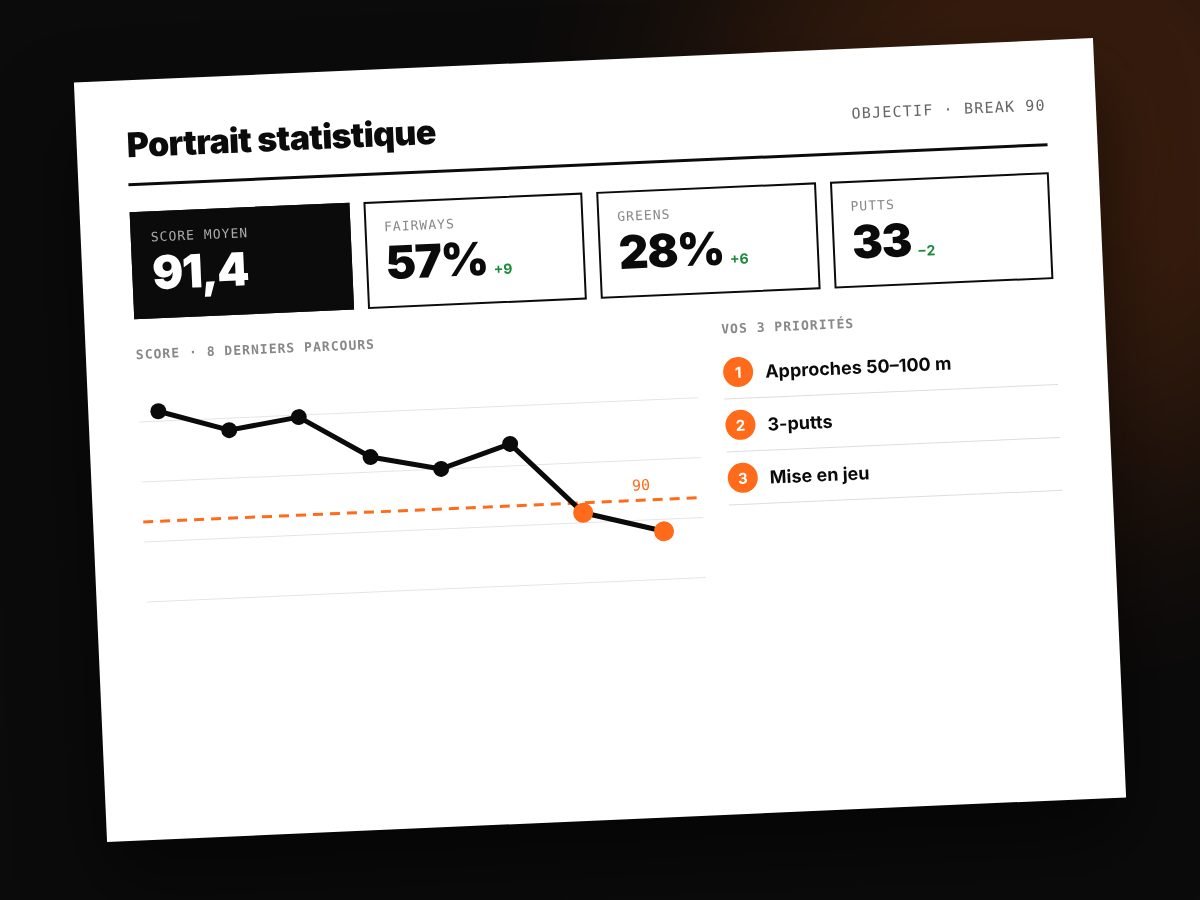
Golf statistics are the simplest and most underrated tool for improving. Most amateurs I meet know their score, sometimes their number of putts, and that's it. Yet five numbers noted on a scorecard are enough to show where your shots are going. And once you know where they're going, you know what to work on. Here is my method, the one I use with my players to turn a feeling (“I played badly”) into a clear priority.
Why track your golf statistics
After a bad round, what sticks is the most dramatic shot: the drive out of bounds, the botched bunker shot. Our memory is selective. The numbers don't lie.
A player can be convinced that his driver is costing him everything, when his stats actually show he's losing three or four shots a round around the green. Without data, he spends his sessions on the driving range with the driver. With data, he works on his short game. That's the whole difference between practising a lot and practising right.
It's also the core of my self-reliant player method: diagnosis, statistics, priorities, plan, measurement. Statistics are the link between what you feel and what you need to do.
The 5 numbers to record on every round
1. Fairways hit
On every par 4 and par 5, note whether your tee shot finishes in the fairway, left or right. The direction of the miss matters as much as the percentage: a player who always misses right doesn't have the same problem as one who misses both ways.
2. Greens in regulation (GIR)
A green is hit "in regulation" when your ball is on the green two shots under par: in 1 shot on a par 3, in 2 on a par 4, in 3 on a par 5. It's the most reliable indicator of the quality of your long game. For amateurs, I also recommend tracking greens in "regulation +1": being on the green one shot more than regulation. It's often a more realistic and more meaningful target.
3. Number of putts
Write down the total, but above all the number of three-putts. A total of 36 putts doesn't say much on its own: it may come from lots of poor approach shots (and so long putts) or from a real distance-control problem. If possible, also note the rough length of your first putt.
4. Penalties
Out of bounds, water hazard, unplayable lie: every penalty is a shot handed to the course, often two once you count the next shot. It's the most profitable stat to bring down, because it depends heavily on your strategic choices, not just your technique.
5. Up & downs
When you miss the green, do you manage to make par (or your “personal par”) in two shots: one chip and one putt? This number measures your short game in real conditions. Note the number of attempts and the number of successes.
How to track your stats without spoiling your round
The trap is wanting to record everything and forgetting to play. Keep it simple:
- On your scorecard, add four small columns: fairway (✓, L or R), green (✓ or not), putts, penalties.
- For up & downs, just a cross when you miss the green and a circle when you save the shot.
- Fill in the line as you walk to the next tee, not during the shot.
- Enter everything in a spreadsheet that same evening, while it's still fresh.
One round isn't enough. You need at least five rounds to start seeing reliable trends. A windy day or a bad night's sleep can skew a single figure; an average over several rounds, far less so.
Benchmarks for your goal: Break 100, 90 or 80
The figures below are rough guides, based on my experience as a coach. They vary with the difficulty of the course, the length of the tees and your profile. Treat them as a compass, not a rule.
- Goal: break 100: hitting few greens in regulation is normal. The priority is mainly to limit penalties (ideally two or fewer per round), avoid double and triple bogeys, and cut down on three-putts.
- Goal: break 90: you start hitting a few greens in regulation and lots of greens in “regulation +1”. Three-putts become rare, penalties exceptional, and your short game lets you save bogey when you miss the green.
- Goal: break 80: this means greater consistency in the long game, hitting around half the fairways or more, several greens in regulation per round, very few three-putts and an up-and-down that works regularly.
If you're aiming to break 100, my dedicated article explains the strategy to adopt: how to break 100 in golf.
Turning the numbers into training priorities
Stats are worthless if they don't change the way you practise. Here's how I read them with a player:
- Lots of penalties: strategy comes first. A shorter club off the tee on tight holes, a wider target, play to the centre of the green. It's often the quickest gain.
- Few fairways, always missing on the same side: targeted technical work on direction, often linked to the clubface at impact.
- Few greens in regulation despite decent fairways: prioritise your irons and ball striking.
- Lots of three-putts: work on pace on long putts, far more than on short putts.
- Weak up & down stats: short-game sessions with measurable targets.
My rule: two priorities maximum at a time. Choose the one that costs you the most shots and the one that's quickest to fix. Work on them for four to six weeks, then record your stats again to measure the effect. It's this cycle (measure, choose, work, measure again) that leads to lasting improvement.
Take action with real follow-up
To get started, download my free guide “The 7 steps to becoming a self-reliant golfer” (in French): it sets out the method and where statistics fit into your progress. If you want to go further, the full edition of the 7 steps gives you ready-to-use tracking files to record your numbers round after round and work out your priorities.
And if you'd rather have support analysing your data and building your training plan, that's exactly what I do in my online golf coaching, starting with a free 30-minute assessment call.