Golf handicap index: how it's calculated and how to lower it

The golf handicap index is the number every amateur golfer knows by heart, yet few can really explain. How it's calculated, why it moves and, above all, how to bring it down: that's what we'll look at here. Understanding your handicap index is the first step to managing your progress better.
What is a golf handicap index for?
Your handicap index measures your potential playing level, not your average score. That's an important distinction. It lets two players of different levels play together on equal terms, thanks to strokes received, and lets you track your progress over time.
Since 2020, most countries have used the same system: the World Handicap System (WHS), run by R&A and the USGA, and applied in France by the French Golf Federation. So a handicap index reads the same way all over the world.
Slope and course rating: how difficult the course is
To compare scores played on different courses, the WHS uses two values specific to each set of tees on each course:
- The course rating (SSS): the expected score of a "scratch" player (handicap index 0) on that course. For example 72.4.
- The slope rating: how difficult the course is for an average player compared with a scratch golfer. It ranges from 55 to 155, with a standard value of 113. The higher the slope, the harder the course is for an average player.
Both values are shown on the scorecard or at the clubhouse. They change depending on which tees you play.
How the golf handicap index is calculated under the WHS
Step 1: the adjusted score
On each hole, your score is capped at net double bogey: the hole's par, plus 2, plus any strokes you receive on that hole. So an 11 on a par 4 won't wreck your calculation. This gives you your adjusted gross score.
Step 2: the score differential
Each scorecard becomes a differential with this formula:
Differential = (113 / slope) × (adjusted gross score − course rating − PCC)
The PCC is an automatic adjustment that accounts for abnormal playing conditions on the day (strong wind, very soft course). Most of the time, it's zero.
Example: you shoot an adjusted 95 on a course with a course rating of 72 and a slope of 130. Your differential is 113 / 130 × (95 − 72) = about 20.0.
Step 3: the average of the best 8 out of 20
Your handicap index is the average of the best 8 differentials from your last 20 scores. If you have fewer than 20 scores, an official table determines how many differentials count. It updates with every new scorecard you submit.
The rules governing the handicap index
- Maximum handicap index: 54.0, for men and women alike.
- A first handicap index is obtained after submitting scorecards totalling at least 54 holes.
- The soft cap and hard cap limit sharp increases: beyond a 3-stroke rise compared with your lowest handicap index over the last 12 months, the increase is halved, and it can never exceed 5 strokes.
Practical arrangements (9-hole scorecards, score submission) may vary from country to country: check your federation's rules.
Handicap index and playing handicap are not the same
On the day you play, your handicap index is converted into a course handicap for the course and tees you choose: index × (slope / 113) + (course rating − par). On a difficult course, you receive more shots. That's normal.
What your handicap index really says about your game
Since your handicap index uses your best 8 scores out of 20, it reflects your good day, not your average day. A player with an 18 index doesn't play 18 over the course rating every round: their average is often higher. That's not a flaw, it's the principle.
The consequence is simple: to lower your handicap index, one exceptional scorecard isn't enough. You need to raise the level of your “normal” rounds and cut out the big numbers.
How to lower your golf handicap index in practice
1. Measure before you practise
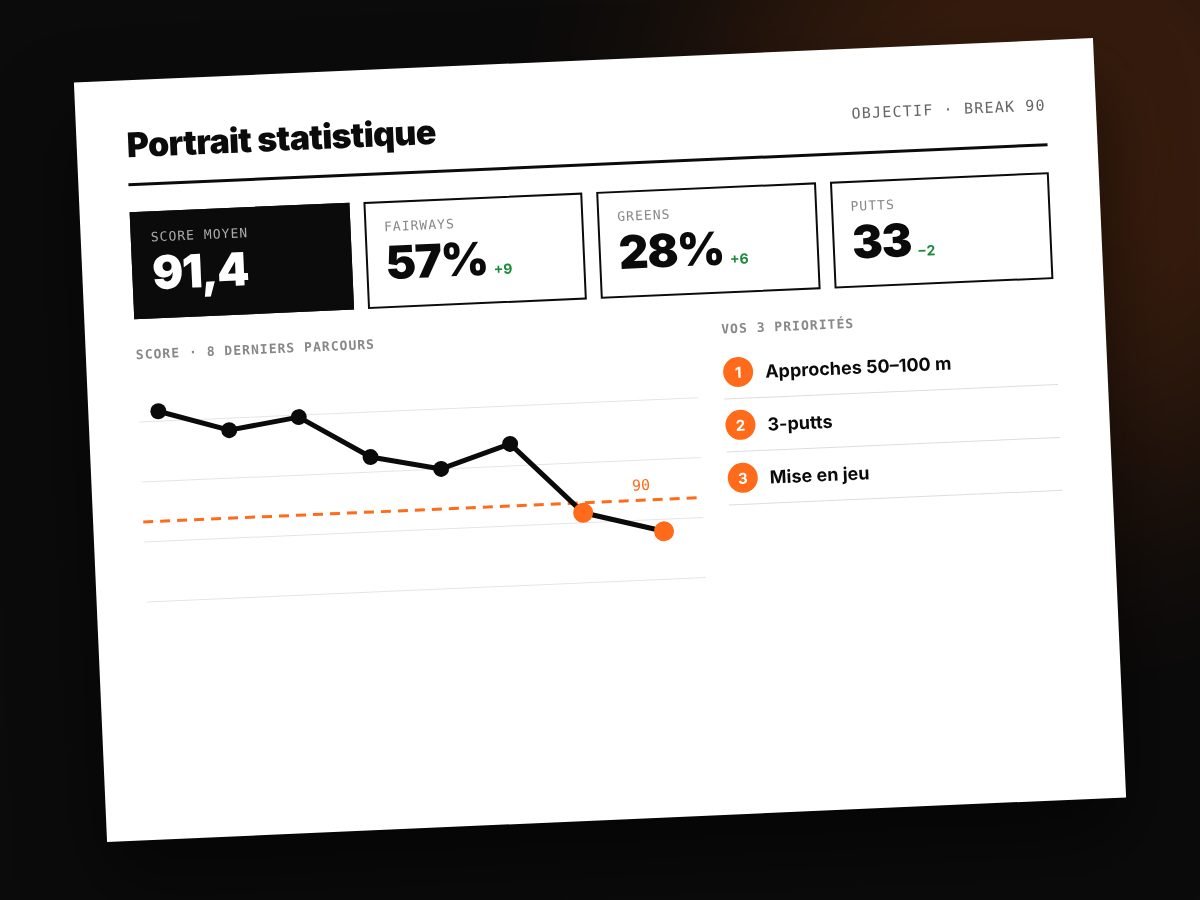
Every round, note a few simple statistics: fairways hit, greens in regulation, number of putts, penalty shots, and number of double bogeys or worse. After 5 to 10 rounds, you'll know where your shots are going. That's the starting point of my method: you don't work on what you feel like working on, you work on what costs you shots.
2. Eliminate the big numbers
For a player with a handicap index between 15 and 25, triple bogeys and penalties often cost more than everything else put together. A tee shot in the fairway with a 3-wood or a hybrid, a chip out sideways rather than a heroic shot, and many scorecards improve without touching the swing.
3. Work on your short game and putting
Fewer than 3 putts per round, more balls finishing within 2 metres around the green: that's the quickest lever for most amateurs. Spend at least half of your practice time on it.
4. Submit scorecards regularly
A handicap index feeds on scores. Submit your rounds whenever you can, including casual rounds if your federation allows it. The fuller your record, the more your index reflects your true level.
5. Follow a plan
Set one priority at a time, for a few weeks, and measure the result in your stats. If the number moves, you move on. If not, you adjust.
Taking action to lower your handicap index
Everything I've just described (assessment, statistics, priorities, plan, measurement) is at the heart of my free guide “The 7 steps to becoming a self-reliant golfer”. It's the best starting point to structure your work.
If you want close support, my online or hybrid coaching starts from your own stats to build a plan that suits you. And to save shots from your very next round, read my article on the pre-shot routine.